
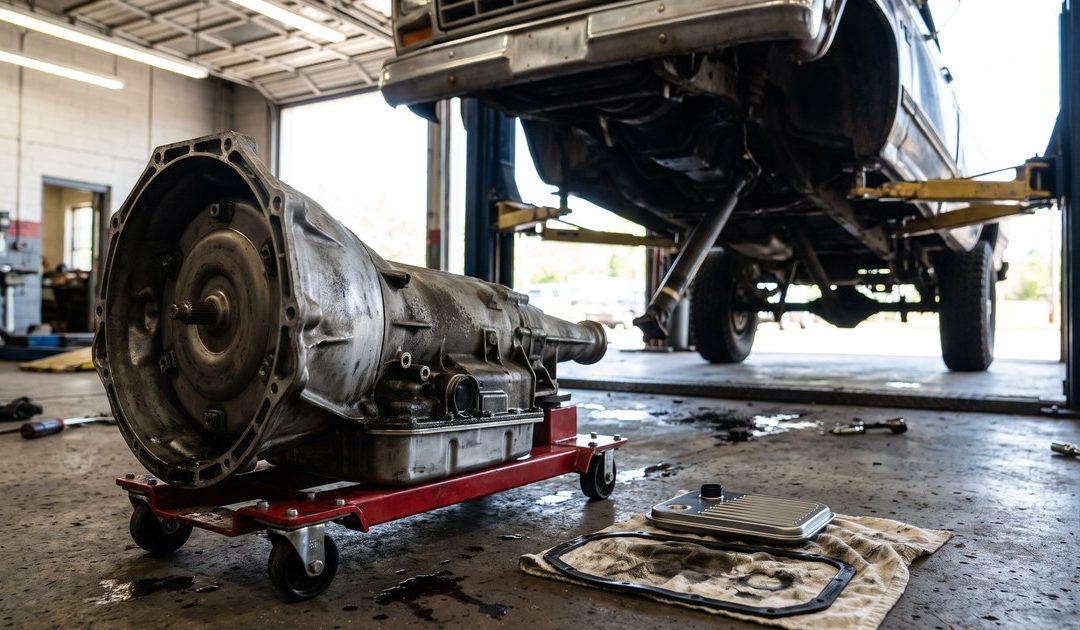
Most transmission repairs take anywhere from a few hours to a couple of weeks, and the honest answer for your vehicle depends on what is actually wrong. A fluid and filter service is often a same-day job. A minor sensor or solenoid fix usually wraps up in about a day once the part is in hand. A full rebuild or a replacement unit can run several days to two weeks, mostly because of parts and the amount of work involved. This guide walks through what sets that timeline, so a Yukon driver knows what to expect before the work starts and why a fast phone quote is rarely the whole story.
Key Takeaways
- Simple transmission work, like a fluid and filter service, is commonly a same-day job, while a full rebuild or replacement often takes several days to two weeks.
- The biggest variables are the type of repair and parts availability, not just labor hours, so two jobs on the same symptom can finish days apart.
- Diagnosis comes first. Today’s transmissions are electronic, so a scan and a road test are what set the real timeline.
- Preventive fluid service is the cheapest way to keep a small issue from turning into a long, expensive repair.
- Ranchwood Autoworks gives an upfront estimate after inspection instead of a guess over the phone. Call 405-350-1951 for repairs in Yukon, OK.
How long do transmission repairs take? The short answer
Vehicles are lasting longer, which means more transmissions are reaching the age where they need real work. The average age of vehicles on U.S. roads rose to a record 12.8 years in 2025, with passenger cars averaging 14.5 years, according to S&P Global Mobility. Older vehicles are exactly where transmission questions come up, and the time in the shop varies widely by the kind of repair.
Here is a realistic range for common transmission jobs. Treat these as general guides, not promises, because your specific vehicle, its condition, and parts supply all move the number.
General guides, not promises
Typical time in the shop, by job
Bars show the upper end of each range. Parts supply moves these numbers more than labour hours do, which is why two jobs on the same symptom can finish days apart.
| Type of transmission work | What is involved | Typical time in the shop |
|---|---|---|
| Diagnosis and road test | Scan codes, check fluid, test drive | Often started the same day |
| Fluid and filter service | Drain, replace filter, refill, reset | Usually same day |
| Minor repair (sensor, solenoid, external leak, mount) | Replace a part and retest | Commonly about one day, parts permitting |
| Major internal repair (valve body, clutch pack, torque converter) | Remove, open, rebuild a section, reinstall | Often two to four days |
| Full rebuild or replacement | Pull the unit, rebuild or install a reman, reprogram | Commonly several days to two weeks |
If you want the signs to watch for and the cost side of the picture, our companion piece on transmission repair in Yukon, OK covers the symptoms and what comes next. This guide stays focused on timing.
What decides how long a transmission repair takes
Labor availability shapes every shop’s schedule, and the trade is tight. The U.S. Bureau of Labor Statistics projects about 66,200 openings per year for automotive service technicians and mechanics over the decade, with employment growing 5 percent from 2025 to 2035, per the BLS Occupational Outlook Handbook. Skilled hands are in demand, so the shops that keep experienced technicians on the bench are the ones that turn work around without cutting corners.
Beyond staffing, five things move a transmission timeline the most:
- The type of repair. A fluid service and a full rebuild are not the same job, and the table above shows how far apart they sit.
- Parts and availability. A common sensor may be on the shelf. A rebuild kit or a remanufactured unit for a specific model can add days if it has to be ordered in.
- Diagnosis time. A clear trouble code speeds things up. An intermittent shift problem can take longer to pin down because it has to be reproduced.
- Vehicle type. A front-wheel-drive car, a rear-wheel-drive truck, and a diesel each take different amounts of labor to reach and service the transmission.
- Condition of the vehicle. Rust, prior repairs, or related damage can turn a clean job into a longer one once the unit is out.
You can see the full menu of what we handle on our repair services page, from engine diagnostics to major repairs, which is the same range of factors that decides a transmission timeline.
Diagnosis comes first, and it sets the clock
Catching a problem early keeps a repair short, and plenty of drivers wait too long. In 2024, AAA received more than 27 million emergency roadside service calls across the country, most for towing or dead batteries, according to AAA. A transmission that gets looked at when the first symptom shows up is almost always a faster, smaller fix than one that gets driven until it strands you.
Modern transmissions are computer-controlled, which changes how diagnosis works. As our team puts it, in today’s vehicles transmissions are fully electronic, and it is a disservice to give a price over the phone before anyone has looked at the vehicle. The same is true for the timeline. Two common warning signs are slipping gears and a grinding noise when the vehicle shifts. Both point to different repairs with different timelines, and the only way to tell them apart is a proper diagnosis, which usually includes a computer scan and a road test.
For trucks, the diagnosis step matters even more. A heavy-duty or diesel transmission carries more load and more parts, so our diesel repair team treats the scan and inspection as the step that prevents surprises later in the job. Getting the diagnosis right up front is what keeps a two-day repair from becoming a two-week one.
Repair, rebuild, or replace: how the choice changes the timeline
The repair path drives both the time and the cost, and transmission work sits at the high end of vehicle expenses. AAA’s 2025 Your Driving Costs study puts maintenance, repair, and tire costs at 11.04 cents per mile for a new vehicle, part of an average ownership cost of $11,577 a year, per the AAA fact sheet. A major transmission job is one of the larger single repairs a vehicle will face, so it is worth understanding the three routes.
- Targeted repair. When the failure is a specific external part, like a solenoid, sensor, mount, or a leaking seal, the fix is contained. These are the jobs that often finish in about a day once the part arrives.
- Rebuild. When the damage is internal, the transmission is removed, opened, and rebuilt with new internal components. This is careful, multi-step work, which is why it commonly takes two to four days or more.
- Replacement. When a rebuild is not the best value, a remanufactured or replacement unit goes in. The install can be efficient, but sourcing the right unit is the part that most often stretches the calendar.
A good shop will explain which path fits your vehicle and give you an estimate before the work begins. We advise you of any issues and provide an upfront estimate, and all of our work is backed by a parts and labor warranty, so you know the plan and the timeline before anything comes apart.
How to keep a small problem from becoming a long repair
Fluid service is the single best defense, and manufacturers spell out intervals for it. Kia, for example, advises replacing automatic transmission fluid about every 60,000 miles under severe usage conditions, per its official maintenance guidance. Every vehicle is different, and the interval typically falls between 30,000 and 60,000 miles depending on the manufacturer’s recommendation. Clean fluid keeps the electronics and clutches working the way they should.
Staying ahead of it is far cheaper than a rebuild. A few habits keep transmissions healthy:
- Change the transmission fluid on the schedule in your owner’s manual, sooner if you tow or drive a lot of stop-and-go around the Oklahoma City metro.
- Address slipping, hard shifts, or warning lights right away instead of waiting.
- Keep up with related cooling-system service, since heat is hard on a transmission.
- Follow a full service schedule so small issues get caught during routine visits.
Routine fluid work fits neatly into a maintenance stop. Our Valvoline Express Care side handles that kind of service, and our car maintenance schedule by mileage guide lays out what to service and when so nothing gets missed.
Getting your transmission looked at in Yukon, OK
Local, experienced help is worth seeking out, especially as skilled technicians grow harder to find. The TechForce Foundation projects that roughly 971,000 new transportation technicians will be needed across the auto, diesel, collision, and aviation fields between 2024 and 2028, per its 2024 Supply and Demand Report. A shop that has kept its team together is where you want your transmission going.
Ranchwood Autoworks has served Yukon and the Oklahoma City metro since 1999, and our ASE-certified technicians work on both foreign and domestic vehicles. You can read more about the shop and the team on our about us page. We give you an upfront estimate after we inspect the vehicle, including a realistic timeline, rather than a guess over the phone. When you are ready, call the shop at 405-350-1951 for auto and transmission repair, call 405-350-3036 for oil changes and maintenance, or use our contact form to set up a visit. You can also stop by the shop at 713 S Ranchwood Blvd, Yukon, OK 73099.
Frequently Asked Questions
How long does a transmission fluid change take?
A transmission fluid and filter service is usually a same-day job. It involves draining the old fluid, replacing the filter where the vehicle has a serviceable one, refilling with the correct fluid, and clearing any related codes. It is far quicker and cheaper than a repair, which is exactly why staying on schedule pays off.
How long does a transmission rebuild or replacement take?
A rebuild or a replacement commonly takes several days to about two weeks. The internal work is careful and multi-step, and the timeline often depends more on sourcing the right rebuild kit or remanufactured unit than on the labor itself. Your shop should give you an estimated completion window with the estimate.
Why will not a shop quote my transmission repair over the phone?
Because today’s transmissions are fully electronic, and the same symptom can point to very different repairs with very different timelines. A slipping transmission and a grinding shift both need a scan and a road test to diagnose correctly. An upfront estimate after inspection is more accurate than a phone guess, for both the price and the schedule.
Can I keep driving with a transmission problem?
It is risky. Driving on a slipping or grinding transmission can turn a contained repair into a full rebuild, which means more time in the shop and a bigger bill. If you notice slipping, hard shifts, leaks, or a warning light, it is safer and usually faster to have it checked promptly.
Do diesel trucks take longer for transmission work?
Often, yes. Heavy-duty and diesel transmissions carry more load and more parts, and reaching the unit can take extra labor. Accurate diagnosis up front is what keeps a diesel transmission job on schedule, which is why we treat the inspection as the most important first step.