If you have ever booked a brake job and seen “pads and rotors” on the estimate, you have probably asked the same question our Yukon, OK service writers hear every week: why replace rotors when replacing brake pads? The short version is that pads and rotors are a matched pair. Your pads squeeze the rotor to stop the car, so the two wear together, and putting fresh pads against a worn or uneven rotor undoes a lot of what you just paid for.
The longer answer has some good news in it. You do not automatically need new rotors every single time. Sometimes the rotor is healthy enough to keep, sometimes it can be machined smooth again, and sometimes it truly needs to be replaced. The right call comes from measuring the rotor, not from a script. Below is how an honest shop decides, so you know what you are paying for before any work begins.
Key Takeaways
- Pads and rotors wear as a set. New pads seat and stop best against a flat, healthy rotor surface.
- You do not always need new rotors. If a rotor is above its minimum thickness and free of grooves or warping, it can often be reused.
- Every rotor has a minimum (discard) thickness stamped on it. A technician measures with a micrometer and decides from that number.
- New pads on worn or warped rotors mean pedal pulsation, longer stops, and pads that wear out early.
- In Yukon and the OKC metro, ask for the rotor measurement and an upfront estimate before work starts.
Why Do You Replace Rotors When Replacing Brake Pads?
You replace or service rotors during a pad job because the two parts wear together and only work well as a smooth, matched pair. Brake pads last roughly 25,000 to 50,000 miles, or two to five years, according to Kelley Blue Book, and every one of those miles the pad has been pressing into the rotor. By the time the pad is worn, the rotor has usually worn too.
New pads also need a good surface to grab. As the auto-ownership guide from Bumper puts it, new pads on worn rotors “produce suboptimal brake feel and accelerated pad wear,” while “new pads bed in best against a fresh rotor surface.” That is why a full-service brake shop treats the rotor as part of the job. Les Schwab describes its own brake service this way: “While other shops might do the bare minimum and replace only worn-out brake pads, we service the full system,” and “we resurface or replace the rotors every time.” The point is not to sell parts. It is that new friction material against a scored or warped rotor cannot do its job.
Do You Have to Replace Rotors Every Time You Change Pads?
No, you do not always need brand-new rotors, and any shop that tells you otherwise without measuring is guessing. Bumper’s guide is clear that “if rotors are in good condition (above minimum thickness, no scoring, no pulsing), they can often be reused when pads are replaced.” Whether yours qualify comes down to a number.
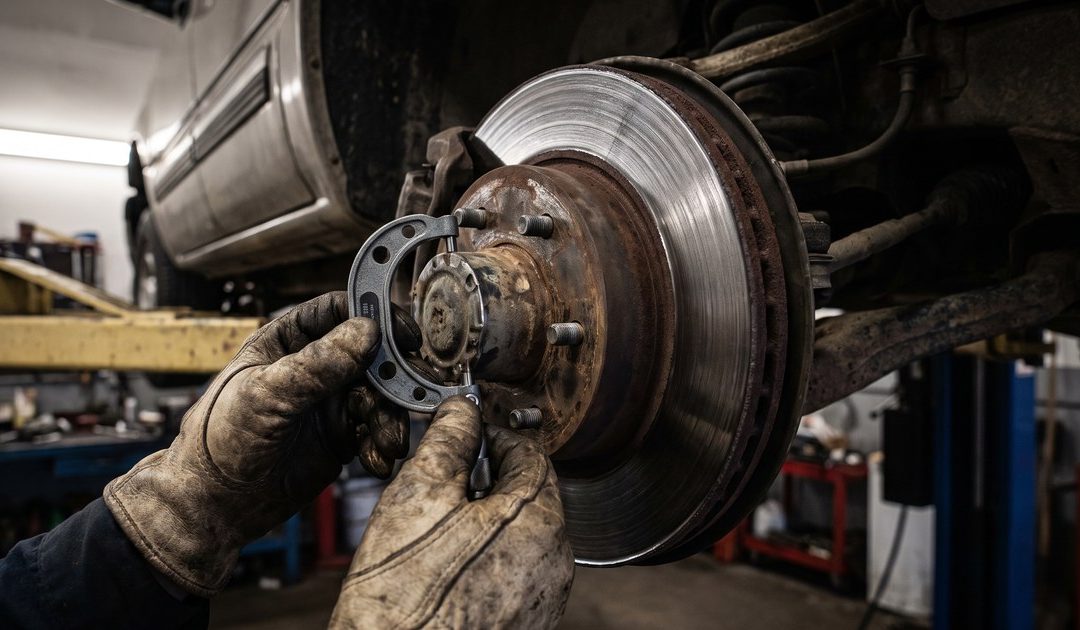
Every rotor is built with a minimum thickness, sometimes called the discard thickness, and that figure is stamped or cast right into the rotor. A technician measures the rotor at several points with a micrometer and compares the reading to that minimum. Les Schwab describes the same step: technicians “measure your rotor thickness with a micrometer to ensure it is well above the minimum for your vehicle,” and they “examine the rotor for grooves or uneven wear,” which “can indicate the need for a replacement or resurfacing.” If the rotor is thick enough and the surface is clean, keeping it is a fair and honest option.
What Happens If You Put New Pads on Worn or Warped Rotors?
Installing new pads on bad rotors gives you worse braking and wastes the new pads, so it is a false savings. A grooved rotor has less flat surface for the pad to grip, which can lengthen stopping distance and make the pads wear unevenly. A warped or uneven rotor has thick and thin spots, and as Bumper explains, “as the caliper passes over thicker and thinner sections, it pulses the brake pedal.” That is the pulsing pedal or steering shimmy many drivers feel when they brake from highway speed.
Here is how the common symptoms line up with what is usually happening at the wheel:
| What you feel or hear | Likely rotor condition |
|---|---|
| Pulsing pedal or steering shimmy when braking | Warped or unevenly worn rotor |
| Deep grooves you can feel with a fingernail | Scored rotor surface |
| Squeal that turns to grinding | Pads worn down to metal, rotor being damaged |
| Longer stopping distance, soft feel | Glazed or worn rotor and pad surfaces |
Skimping here tends to cost more later. Fresh pads riding on a rotor that is already too thin or warped will wear faster and can bring the noise and vibration right back.
Resurfacing vs. Replacing Rotors: How the Decision Is Made
Resurfacing, also called turning or machining, shaves a thin layer off the rotor to make it flat and smooth again, and it is only an option when the rotor will still stay above its minimum thickness afterward. Because machining removes metal, a technician has to measure first and do the math. If turning the rotor would drop it below the stamped discard thickness, the rotor is done and needs to be replaced. Many rotors on newer vehicles are made thinner and lighter to save weight, so there is often little or no metal to spare, which is why replacement has become more common than it once was.
The decision, again, is driven by measurement and condition rather than by mileage alone. A rotor that measures well above minimum with only light surface wear may be resurfaced and reused. A rotor with deep scoring, cracks, hard spots, or too little thickness gets replaced. When we service brakes as part of our auto repair services, we show you the reading and explain which category your rotors fall into before we touch them.
How Long Do Brake Rotors Last in Oklahoma Driving?
Front rotors generally last 50,000 to 80,000 miles under normal driving, with rear rotors lasting longer because the front brakes handle about 70 percent of the braking work, according to Bumper’s rotor guide. Those are averages, though, and your driving decides where you land in the range. Frequent hard stops, towing, hauling, and stop-and-go traffic all wear rotors faster.
That matters here in the Oklahoma City metro. Daily stop-and-go on I-40 and the Kilpatrick Turnpike, hot summers, and heavy-load driving put Oklahoma vehicles in severe-duty territory, which is harder on brakes than steady highway cruising. Oklahoma also does not require periodic safety inspections, so no one is checking your rotors on a schedule but you. That makes an annual brake inspection worth putting on the calendar. You can read the warning signs to watch for in our brake repair guide for Yukon, OK.
Service life, front and back
Why the front rotors are the ones that wear out
Pads and rotors wear as a matched pair, and the front axle does most of the stopping. Those are averages: towing, hauling and stop-and-go put you at the short end.
25,000-50,000 mi
typical brake pad life, or two to five years
50,000-80,000 mi
typical front rotor life under normal driving; rear rotors last longer
70%
of the braking work handled by the front brakes, which is why the fronts go first
Signs Your Rotors and Pads Need a Look
The clearest signs your brakes need attention are pulsation, noise, and any change in how the car stops. Watch and listen for these:
- A pulsing brake pedal or a shimmy in the steering wheel when you slow down
- Squealing that turns into grinding, which usually means the pad is gone and metal is hitting the rotor
- Deep grooves or a lip you can feel on the rotor edge
- Longer stopping distances or a brake pedal that feels soft
- A burning smell or blue discoloration on the rotor after hard stops
If you notice any of these, do not wait for the next oil change. Catching a worn pad early can save the rotor underneath it, while ignoring it can turn a routine pad job into pads, rotors, and calipers. Brakes should be examined at least once a year, and sooner if something feels off.
Honest Brake Service in Yukon, OK
The best brake job is the one that fixes exactly what your car needs and nothing it does not. Ranchwood Autoworks has served Yukon and the OKC metro since 1999, and our ASE-Certified technicians measure your rotors and give you an upfront estimate before any work begins. If your rotors are healthy, we will tell you. If they need resurfacing or replacement, we will show you why. Our work is also backed by a nationwide warranty honored at repair centers across the country.
Keeping up with brakes protects a real investment. AAA reports that the total cost of owning and operating a new vehicle reached $11,577 per year, or $964.78 per month, in 2025, so it pays to keep the parts that stop the car in good shape. Simple habits help too, and quick preventive maintenance like our Valvoline oil change service next door keeps you on a schedule where brake wear gets spotted early.
Ready for a straight answer on your brakes? Call our auto repair team at 405-350-1951, reach the oil change and maintenance lane at 405-350-3036, or send us a note through our contact page. You will find us at 713 S Ranchwood Blvd, Yukon, OK 73099.
Frequently Asked Questions
Do I need new rotors every time I get new brake pads?
Not always. If your rotors measure above their minimum thickness and have no deep grooves, cracks, or warping, they can often be reused with new pads. The only way to know is to have a technician measure them with a micrometer, which is exactly what should happen before any parts go on the estimate.
Can you just resurface my rotors instead of replacing them?
Sometimes. Resurfacing works when the rotor will still sit above its stamped minimum thickness after machining. If turning the rotor would take it below that discard number, or if it is cracked or badly scored, it needs to be replaced for safety. Many newer rotors are built thin, so there is often no metal to spare.
How much does a brake job cost?
Costs vary by vehicle and by what the brakes actually need. Kelley Blue Book puts disc brake pad replacement at around $300 per axle as a general figure, but rotors, calipers, and labor change the total. We give an upfront estimate after we inspect and measure your brakes, so you see the number before we start.
How do I know if my rotors are warped?
The most common clue is a pulsing brake pedal or a shimmy you feel through the steering wheel when braking, especially from higher speeds. Warping creates thick and thin spots on the rotor that push back against the caliper. If you feel that pulse, have the brakes inspected soon.
How often should I have my brakes inspected?
At least once a year is a good rule, and more often if you tow, haul, or drive a lot of stop-and-go miles around the OKC metro. Because Oklahoma does not require a periodic safety inspection, a yearly brake check is the simplest way to catch wear before it becomes a bigger repair.